quick_actions_kit
Home-screen quick actions for DartNative on iOS 15+ and Android API 26+. Version 0.1.0. See VALIDATION.md for tested environments and remaining qualification limits.
DartNative catalogue · Source repository · Report an issue
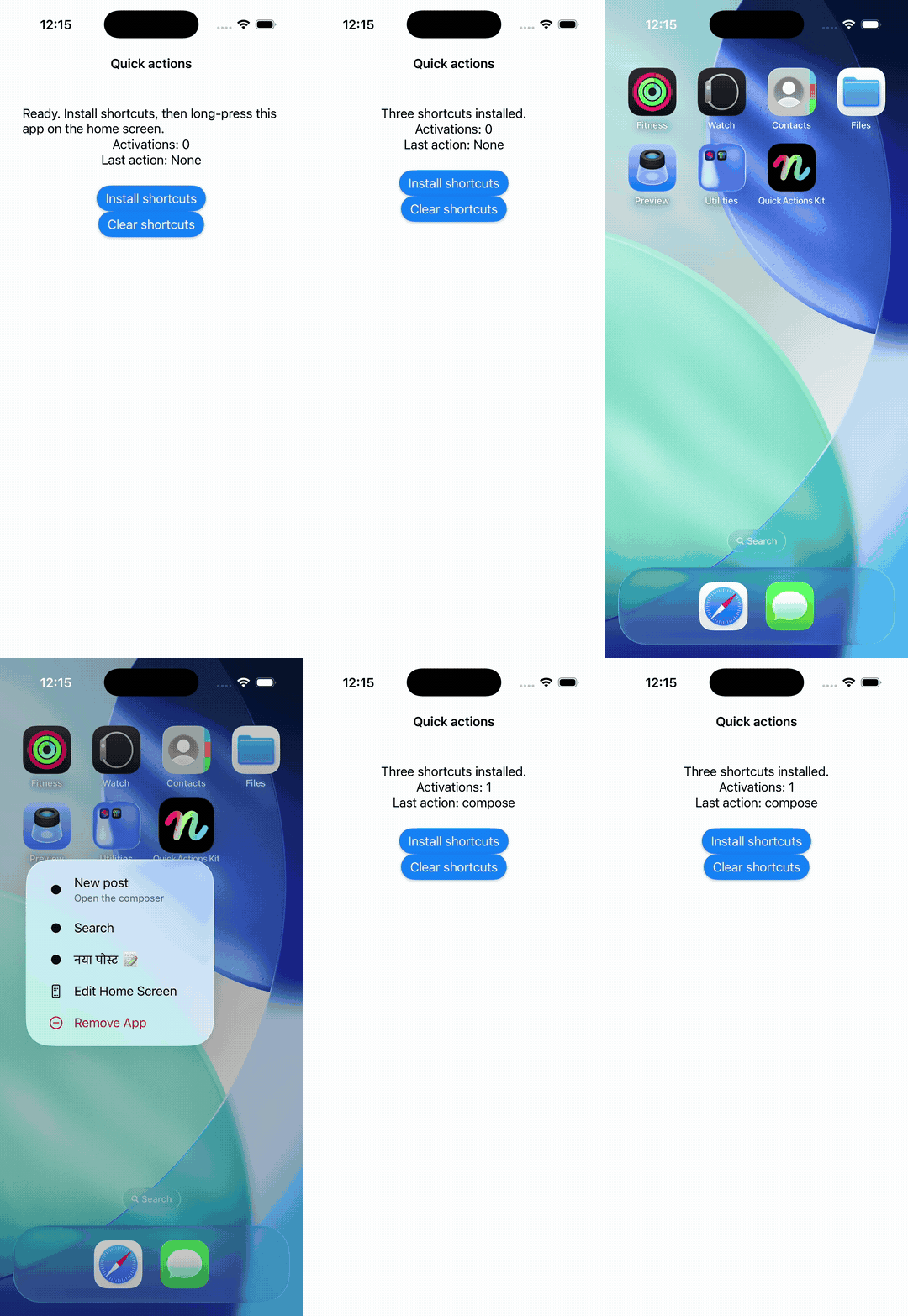
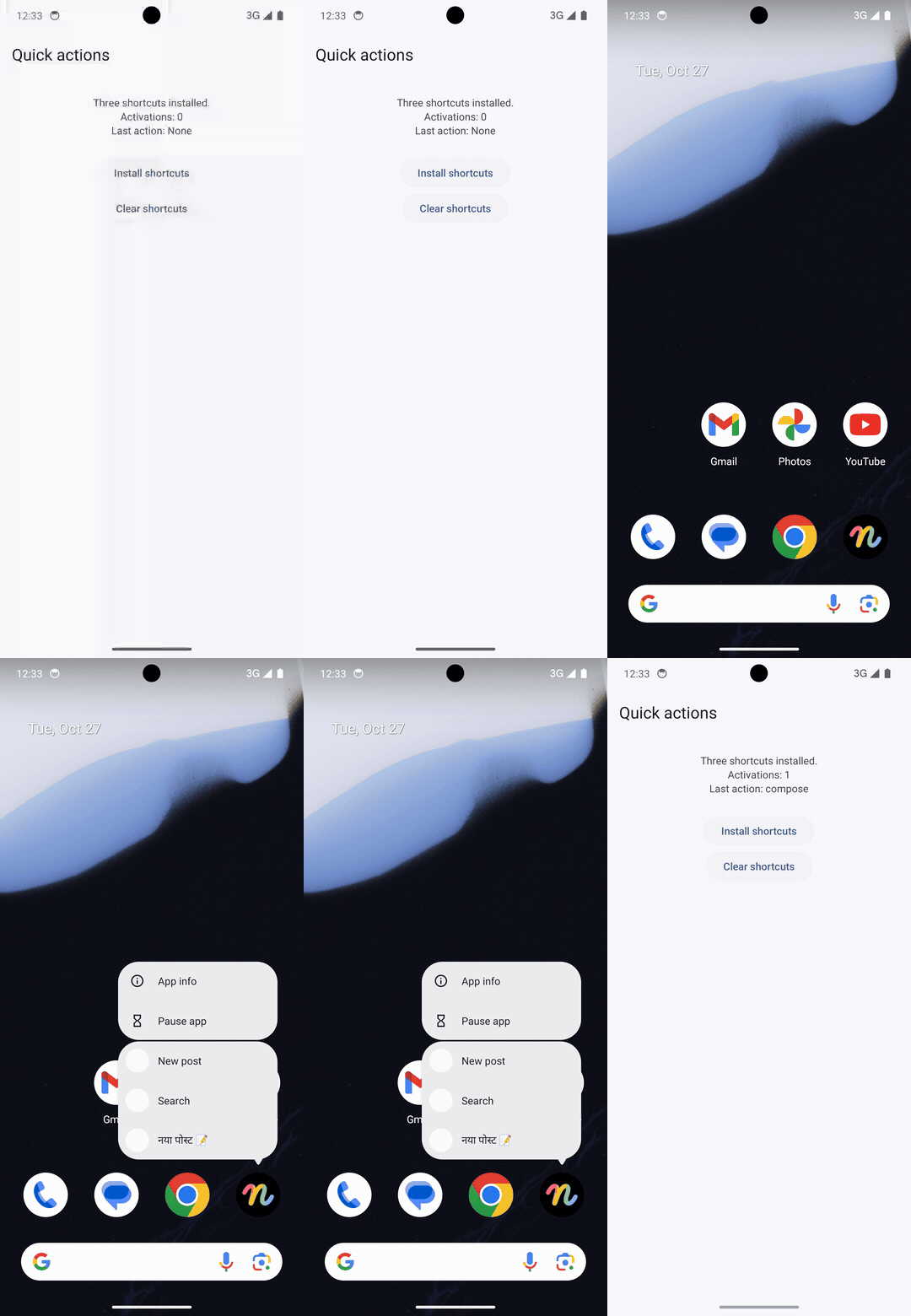
Demo
Open the launcher menu, choose New post, and observe
Last action: compose with one activation. Recorded using the actual home-screen
menus on dedicated clean devices. Android starts with the shortcuts installed.
Only static waiting time is trimmed.
| iOS 26.5 simulator | Android 14 emulator |
|---|---|
 |
 |
API
import 'package:quick_actions_kit/quick_actions_kit.dart';
// Your app calls generated DartNativePluginRegistrant.registerAll() first.
final actions = QuickActions();
await actions.initialize((type) {
// Treat this as navigation intent; the app still validates session/permissions.
});
await actions.setShortcutItems([
const ShortcutItem(type: 'compose', localizedTitle: 'New post', icon: 'ic_compose'),
]);
await actions.clearShortcutItems();
await actions.dispose(); // Stops delivery, does not clear shortcuts.
Install from the DartNative registry (the explicit host is required on DN 1.4.0):
dependencies:
  quick_actions_kit:
    hosted: https://dartpub.dev
    version: ^0.1.0
For local development, see the example instructions. Each host owns its navigation and user policy. No Orb routes, accounts, credentials or private dependencies are included.
Behaviour
- Dynamic replacement/clear; static and pinned shortcuts are separate OS concepts.
- One app-wide owner. Reinitializing replaces the handler without another native listener.
- Cold taps buffer until initialize; warm taps deliver through one native dispatcher. Repeated taps are independent events. The bounded native queue keeps the latest 32.
- Types/titles must be nonempty; types unique within an update. Values are copied before async mutation. Native failures propagate as QuickActionsException.
- iOS permits up to four requested dynamic items; static entries can reduce what
the launcher displays. Subtitle is iOS-only.
iconis an iOS template-image name or Android drawable/mipmap resource. Missing icon falls back to OS presentation. - Android enforces the platform shortcut limit and reports rate-limit rejection.
- Main isolate only. Commands are serialized; a request times out after 15 seconds. A timeout means the outcome is uncertain, not that native execution was cancelled.
- New package, not an import-only migration: shortcut ids can be retained, but installed shortcuts should be refreshed on upgrade because the Android target activity changes. Pinned/static legacy entries require a separate migration policy.
Native architecture
This is a service plugin, with no NativeElement or native rendered view.
- iOS: Dart FFI → Swift C ABI → UIKit. The public DN scene event hub handles initial and warm shortcut taps. Unsupported hub/callback APIs fail initialization.
- Android: Dart FFI → C++ JNI → Kotlin ShortcutManager. The pluginClass loads the shared library via the JVM. A manifest-provided no-display receiver forwards to the normal launcher and buffers cold input before engine initialization. No private framework-class dependency is required for standalone AAR packaging. Public Application lifecycle callbacks hold events until the launcher resumes.
- iOS registers one dispatcher slot; Android checks DN_IsolateGen before each callback. Queued requests carry generation/session identity. Native delivery stays on the main thread. A Dart lifecycle observer refreshes registration on resume, including activity recreation that retains the isolate. Request strings are copied; synchronous dispatcher strings stay native-owned only until Dart copies them. JNI uses UTF-8 bytes.
The Android receiver is exported because launchers invoke it. Its type string is untrusted input, never login/payment authority. It carries no arbitrary URI, file or intent target. App callbacks must validate their own route/session policy.
Development
Initial qualification uses DartNative 1.4.0. Use dn and dart from the same
DartNative SDK installation; see VALIDATION.md for the pinned versions.
dn pub get
dart analyze lib test
dart test
cd example
dn pub get
dn build ios --simulator --debug
dn build apk --debug
The example was generated with dn create --template plugin. Register all
plugins before runApp. There are no manual application delegate edits or runtime
permissions to add. Test long-press launch, terminated launch, repeated taps,
clear, Unicode and hot restart on each platform before a release.
Licence and provenance
Original code is licensed under Apache-2.0. Attribution and upstream licence texts are retained in NOTICE and THIRD_PARTY_NOTICES.md. See provenance.json for the inspected sources and their use.
Published archives include LICENSE and collector-readable NOTICES. No DartNative framework sources or vendor binaries are redistributed as source here.