haptics_kit
Haptic feedback for DartNative apps, with the
haptic_feedback package's API,
so code written for it ports by changing one import:
// import 'package:haptic_feedback/haptic_feedback.dart';
import 'package:haptics_kit/haptics_kit.dart';
Nine types — success, warning, error, light, medium, heavy, rigid, soft and
selection — on iOS (UIKit feedback generators) and Android (Vibrator /
VibrationEffect, optionally HapticFeedbackConstants). It is a pure-FFI
plugin: no view, no method channel, no callbacks into Dart.
Why this package
DartNative's built-in HapticFeedback has only light/medium/heavy impacts,
selection and vibrate, and it does nothing on Android. haptics_kit adds the
notification types (success, warning, error), rigid and soft, canVibrate,
and a real Android implementation that follows the iOS patterns.
| iOS | Android |
|---|---|
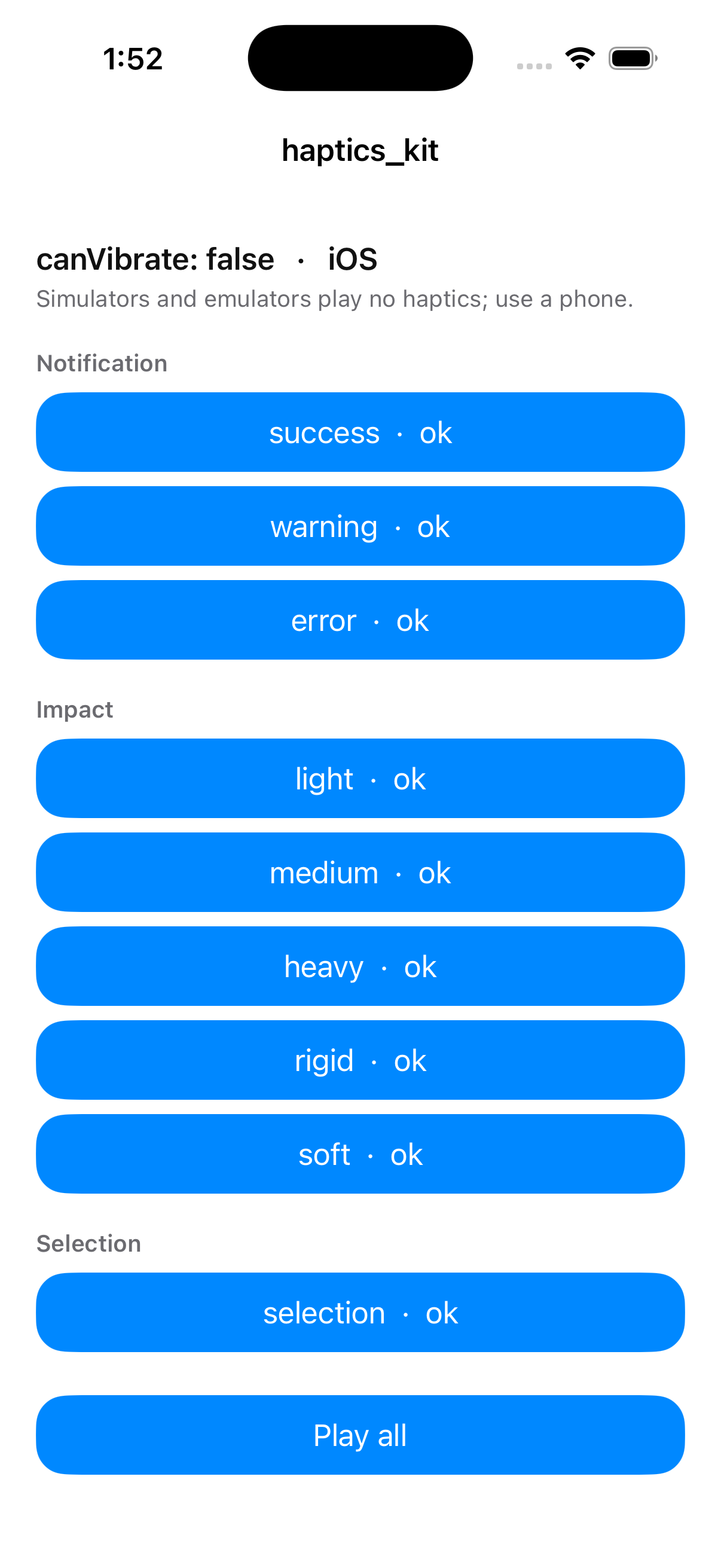 |
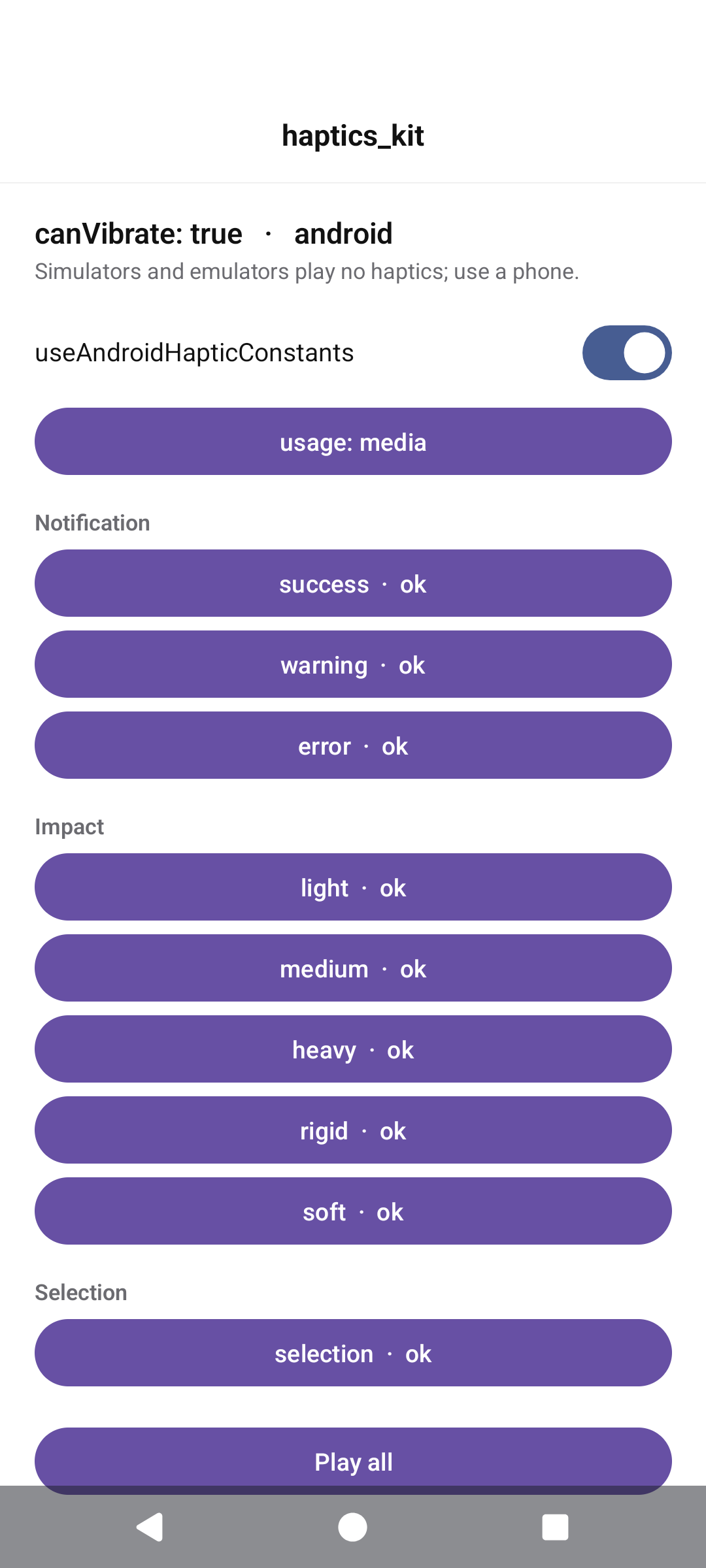 |
Install
dependencies:
  haptics_kit:
    hosted: https://dartpub.dev
    version: ^0.1.0
dn pub get
dn pub get adds the plugin to lib/dartnative_plugin_registrant.dart.
main() needs only the usual first line:
void main() {
  DartNativePluginRegistrant.registerAll();
  runApp(const HomeScreen());
}
Platform setup
iOS: nothing. No
Info.plistkey; the pod links UIKit and CoreHaptics. Minimum iOS 15.Android: nothing to add by hand. The plugin's manifest declares
<uses-permission android:name="android.permission.VIBRATE" />and it is merged into your app. It is a normal install-time permission, with no runtime prompt. Minimum API 24.
Use
import 'package:haptics_kit/haptics_kit.dart';

final canVibrate = await Haptics.canVibrate();
if (canVibrate) {
  await Haptics.vibrate(HapticsType.success);
}

// Android only: route through VibrationAttributes (API 33+), or prefer the
// system's HapticFeedbackConstants where one fits.
await Haptics.vibrate(
  HapticsType.heavy,
  usage: HapticsUsage.media,
  useAndroidHapticConstants: true,
);
vibrate throws HapticsException (code is unavailable, unknownType
or nativeError) when the native side is missing or fails. A helper that
caches canVibrate() and catches everything is the usual app-side wrapper.
What happens where
| Situation | canVibrate() |
vibrate(t) |
|---|---|---|
| iPhone with a Taptic Engine | true | plays; silent if System Haptics is off |
| iPad, iOS Simulator | false | runs, nothing felt |
| Android with a vibrator, API 30+ with primitive support | true | composition primitives |
| Android API 26+ with amplitude control | true | amplitude waveform |
| Android API 26+ without amplitude control, or API 24–25 | true | on/off waveform |
| Android without a vibrator | false | nothing (the constants path may still play) |
| Android emulator | usually true | nothing felt |
usage on iOS or Android < 33; useAndroidHapticConstants on iOS |
— | ignored |
macOS / Linux / Windows / dn test host |
false | nothing |
Native side missing (registerAll() not called) |
false | throws HapticsException('unavailable') |
With useAndroidHapticConstants, success/error map to CONFIRM/REJECT
(API 30+), light to VIRTUAL_KEY, medium to KEYBOARD_PRESS, heavy to
CONTEXT_CLICK and selection to CLOCK_TICK; warning, rigid and soft, or no
resumed activity, fall through to the vibrator. Some OEM builds mute
USAGE_UNKNOWN vibrations when touch haptics are off; pass usage: if that
matters.
Example
example/lib/main.dart has one button per type,
canVibrate, "Play all", and on Android the constants switch and a usage
picker.
cd example && dn pub get && dn run
Differences from haptic_feedback
HapticsExceptionreplacesPlatformException/MissingPluginException.- No platform interface; tests set
Haptics.debugBackendOverrideto aHapticsBackendfake instead. - iOS 15 minimum, so the pre-iOS-13 fallbacks and the private
_feedbackSupportLevellookup are gone. - Android:
softfalls back to TICK on API 30 (upstream's check made that fallback unreachable), and the on/off waveform usesVibrationEffecton API 26+.
Credits & license
- haptic_feedback 0.6.5 by
Joachim Nohl, BSD-3-Clause. It is the source of the API and its docs, the
iOS type-to-generator mapping, and the Android patterns (timings,
amplitudes, primitives,
HapticFeedbackConstantsmapping) and fallback chain. They were reworked from method channels to FFI; those portions stay under BSD-3-Clause. - This package's own code: MIT, see LICENSE.
- Full notices are in THIRD_PARTY_NOTICES, which ships with the package.