biometric_storage_kit
Biometric-protected UTF-8 secret storage for DartNative on iOS and Android.
Initial release: 0.1.0, with limited device qualification. Physical iPhone
Face ID and Android API 34 emulator checks are recorded; this is not full hardware
certification or qualification for a production migration. See validation for the
checks performed and the remaining device/upgrade gates.
Physical iPhone enforcement and a strict-policy synthetic upgrade from the original
biometric_storage 5.0.1 have passed focused checks; full migration/release qualification
remains open. Reproduction fixtures are in qualification.
| Platform | Native path | Protection for new records |
|---|---|---|
| iOS | Dart FFI → Swift → Keychain / LocalAuthentication | whenPasscodeSetThisDeviceOnly + biometryCurrentSet |
| Android | Dart FFI → C++ JNI → Kotlin → Keystore / BiometricPrompt | AES-256-GCM key requiring a strong biometric for every crypto operation |
Original code is Apache-2.0. This is a storage service, with no wallet signing, account recovery decisions, backend identity, or application navigation.
Local use
Add the hosted dependency to your app:
dependencies:
  biometric_storage_kit:
    hosted: https://dartpub.dev
    version: ^0.1.0
Run dn pub get and call the application's generated
DartNativePluginRegistrant.registerAll() before runApp. Use the plugin from
the main isolate. It supports one native operation at a time across instances.
import 'package:biometric_storage_kit/biometric_storage_kit.dart';

final storage = BiometricStorage(namespace: 'my-app');
final availability = await storage.checkAvailability();

if (availability == BiometricAvailability.available) {
  await storage.write('example', 'Synthetic secret');
  final value = await storage.read('example'); // String?; prompts independently
}

// Explicit deletion does not require biometric authentication.
await storage.delete('example');
storage.dispose();
The namespace and name are part of the record identity. Keep them stable across upgrades. Names may contain valid Unicode; no Unicode normalization is performed. Namespaces are limited to 128 UTF-8 bytes, names to 512, prompt fields to 1024, and secrets to 65,536. Empty secrets are valid. Empty identifiers, embedded NUL in identifiers/prompts, and malformed Unicode are rejected before native work.
read returns null only when the OS reports no stored item/file. This does not
prove a secret never existed: iOS can remove items following protection changes.
A missing Android key with existing ciphertext is an error, never absence.
Platform setup
Verified with DartNative 1.4.0 and Dart 3.12.0-192.0.dev. The plugin declares iOS
15+ and Android API 26+. These are build floors, not a claim that every OS version
has been exercised. Android hosts must be resumed FragmentActivity instances;
the audited DN activity satisfies this requirement. The plugin manifest declares
USE_BIOMETRIC and the legacy USE_FINGERPRINT permission.
On iOS, set NSFaceIDUsageDescription in the host's Info.plist and use a correctly
signed application with its own Keychain identity. The included example has a
simulator-only entitlement configuration; a physical-device build needs the
developer's real signing/provisioning configuration. Do not copy the simulator
identity into a production device entitlement or change an existing app's access
groups during migration. See example setup.
There is no passcode fallback for new records. Android requires a strong enrolled biometric. iOS writes request explicit biometric approval, and reads are enforced by the item's Keychain access control. A standalone biometric prompt followed by unrestricted storage is not used.
Prompts and cancellation
const prompt = BiometricPromptOptions(
  title: 'Protected storage',                 // Android
  reason: 'Read the saved demo secret',
  cancelLabel: 'Cancel',
  iosReuseDuration: Duration.zero,
);
final value = await storage.read('example', prompt: prompt);
iOS reuse duration accepts zero through five minutes. It concerns a recent device-unlock biometric match, not a cache of arbitrary app authentication. Android always authorizes the individual cryptographic operation.
Overlapping requests fail with busy. On Android, a cancelled prompt can remain
busy briefly while its terminal callback drains. cancelPending() targets only
that instance's active operation; dispose() also rejects future operations.
Backgrounding cancels pending prompt ownership. Native host/isolate changes
invalidate stale work and callbacks.
Cancellation, native reset, or the three-minute timeout cannot undo an already committed write/delete. Treat the result as uncertain and reconcile explicitly; never blindly retry a mutation. The plugin performs no automatic retry, key rotation, error-triggered deletion, or reset.
Errors and retained data
Catch BiometricStorageException and inspect code; nativeCode is available
when the OS supplies a numeric code. Messages never include secret values.
| Code | Meaning / handling |
|---|---|
cancelled, busy, timeout, native_reset |
Interrupted/overlapping work; respect uncertain mutation outcomes |
not_enrolled, unavailable, locked_out, passcode_not_set |
Authentication prerequisites or OS restrictions |
authentication_failed, interaction_not_allowed, invalid_context |
Authentication/context failure; no secret is returned |
key_missing, key_invalidated, unsupported_key_policy |
Android key unavailable or policy does not satisfy this API; preserve ciphertext |
corrupt_data, storage_error |
Invalid data or storage failure; never treated as missing |
no_foreground_host, engine_detached, unsupported_runtime, native_unavailable |
Host/runtime cannot execute the request |
invalid_request, invalid_response |
Invalid native boundary data |
Android stores versioned IV/ciphertext/tag records in noBackupFilesDir, with
namespace/name authenticated as additional data. Writes sync a temporary file
then replace the target atomically in the same directory. Keys are not exportable
through this API; hardware backing is not promised. Mutable plaintext byte buffers
are cleared where possible; Dart/JVM/Swift strings cannot guarantee memory wiping.
Read-only Flutter compatibility
readLegacyFlutter(originalName) reads the audited biometric_storage 5.0.1
format under the same signed application identity. It does not migrate, rewrite,
or delete the old record. The application's existing storage namespace/name,
signing identity, data container and access-group continuity must be preserved.
- iOS uses service
flutter_biometric_storage, the original account name and default access group. The existing item's ACL controls access; the legacy API does not retrofit new protection onto weak or passcode-enabled legacy items. - Android uses
filesDir/biometric_storage/<name>.v2.txt, alias_CM_<name>_master_key, and the legacy 12-byte IV + ciphertext/tag layout. Only existing per-use biometric-bound keys are accepted. No new key is generated when reading. Unprotected, time-window, or credential-enabled legacy policies are outside this API. Legacy names must be one safe filename component. - The same 64 KiB secret limit applies. Non-default iOS access groups and other plugin versions/formats are unqualified.
An app may read the old value, write it under a new namespace, verify it, and then perform its own migration/activation protocol. Do not infer successful historical upgrade or account recovery from a new-install demo. This package has no authority to decide when old data can be retired.
Demo and validation
The example uses only synthetic data on dedicated devices with no Orb applications. Native recordings are used because the audited Marionette integration requires Flutter and cannot drive DartNative's native UI.
Android emulator
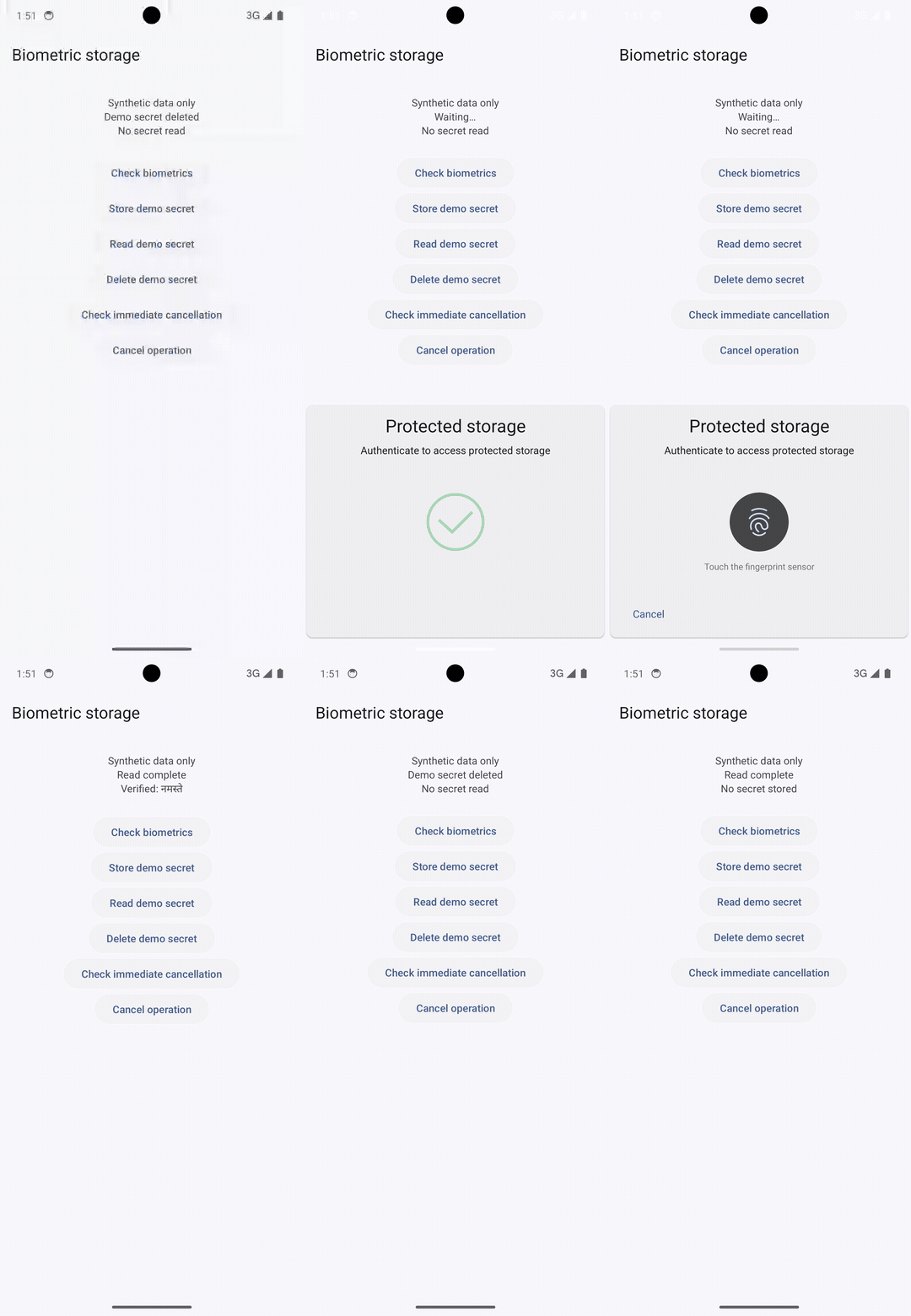
API 34 emulator: separate authenticated write and read, Unicode verification, explicit deletion and an absent read.
iOS Simulator
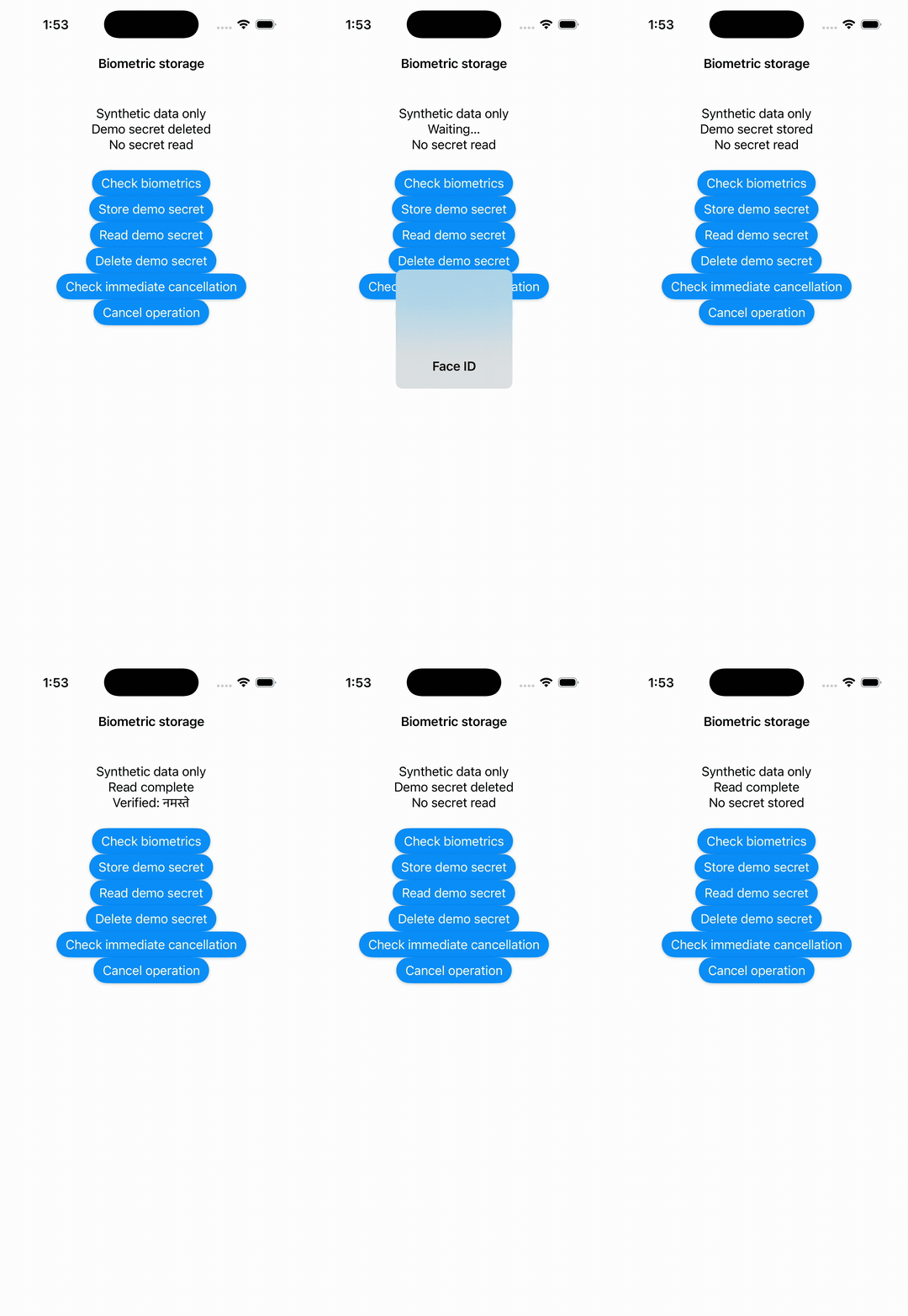
Simulator 26.5: simulated Face ID approves the explicit write, followed by read, delete and absence. This is not proof of Keychain read authentication. This simulator returned the value without a second match, including after cold launch. Apple's published Security source contains a simulator path that skips ACL-constrained wrapping, consistent with that observation; the exact source revision was not matched to this runtime. Focused physical-device read enforcement checks are recorded in validation. Enrollment-change and passcode-removal qualification remain open.
Validation and remaining qualification · Example and reproducible checks · Implementation contract · Provenance
Licence and notices
See LICENSE, NOTICE and THIRD_PARTY_NOTICES.md. Notices are embedded below so the official catalogue artifact retains them.
biometric_storage_kit Copyright 2026 the biometric_storage_kit contributors. Original code is licensed under Apache-2.0.
Third-party notices
Scaffold: DartNative 1.4.0 official plugin template; no SDK runtime source or binaries redistributed. Original FFI transport adapted from Apache-2.0 quick_actions_kit, Copyright 2026 the quick_actions_kit contributors.
biometric_storage 5.0.1 was consulted for API and persisted format compatibility; new implementation is original. Its MIT licence is retained below. Its Android CryptographyManager reference additionally credits the Android Open Source Project under Apache-2.0 (see LICENSE). No private Orb implementation is copied.
Android native dependencies are resolved by the consuming application and are not bundled into this plugin's AAR:
- androidx.annotation:annotation:1.7.1 — Apache-2.0. https://dl.google.com/dl/android/maven2/androidx/annotation/annotation/1.7.1/annotation-1.7.1.pom
- androidx.biometric:biometric:1.1.0 — Apache-2.0. https://dl.google.com/dl/android/maven2/androidx/biometric/biometric/1.1.0/biometric-1.1.0.pom
Copyright The Android Open Source Project. The full Apache-2.0 licence accompanies this package in LICENSE. These are direct declarations, not a fixed list of all transitive versions selected by a consuming app. The Dart ffi dependency is resolved separately under its own BSD-3-Clause licence; the DartNative runtime is supplied by the consuming developer's licensed SDK, not this plugin.
MIT License
Copyright (c) 2019 Herbert Poul (@hpoul)
Permission is hereby granted, free of charge, to any person obtaining a copy of this software and associated documentation files (the "Software"), to deal in the Software without restriction, including without limitation the rights to use, copy, modify, merge, publish, distribute, sublicense, and/or sell copies of the Software, and to permit persons to whom the Software is furnished to do so, subject to the following conditions:
The above copyright notice and this permission notice shall be included in all copies or substantial portions of the Software.
THE SOFTWARE IS PROVIDED "AS IS", WITHOUT WARRANTY OF ANY KIND, EXPRESS OR IMPLIED, INCLUDING BUT NOT LIMITED TO THE WARRANTIES OF MERCHANTABILITY, FITNESS FOR A PARTICULAR PURPOSE AND NONINFRINGEMENT. IN NO EVENT SHALL THE AUTHORS OR COPYRIGHT HOLDERS BE LIABLE FOR ANY CLAIM, DAMAGES OR OTHER LIABILITY, WHETHER IN AN ACTION OF CONTRACT, TORT OR OTHERWISE, ARISING FROM, OUT OF OR IN CONNECTION WITH THE SOFTWARE OR THE USE OR OTHER DEALINGS IN THE SOFTWARE.